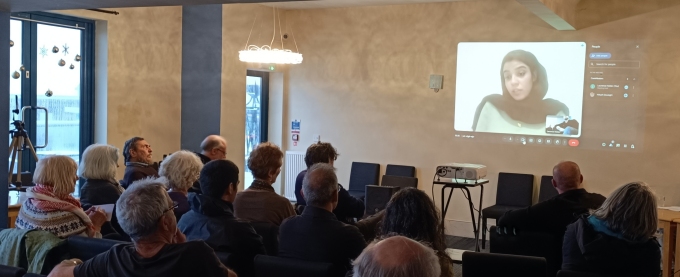
We extend our most sincere thanks to our panel of expert speakers who addressed our December 2025 meeting at the White Rock Hotel on Palestine and Iran.
Each presented detailed and thoroughly researched arguments on both the historic and current geopolitics in the region, as well as analysis of the role of the international solidarity movement.
To do justice to the strength of the material presented, we have drawn up full reports from each of our speakers.
Louis Allday: 'We cannot divorce Palestine from a broader anti-imperialist narrative.'
Dr Helyeh Doutaghi: 'Western sanctions are part of a strategy aimed at Iranian sovereignty.'
Irfan Chowdhury: 'Israel is set to unleash unprecedented destruction and calamity on the entire region next year'
LOUIS ALLDAY: WE CANNOT DIVORCE PALESTINE FROM A BROADER ANTI-IMPERIALIST NARRATIVE
Historian and writer Louis Allday opened the meeting by highlighting the results of a leaked report conducted by Stagwell Global and commissioned by Israel's Ministry of Foreign Affairs this year into attitudes in Europe and the US.
It showed: '....the majority of respondents in all of those countries believe Israel has committed war crimes, and it's killing primarily civilians.'
Further, that the majority in all these countries, except for the US, specifically believe Israel is guilty of genocide and ethnic cleansing.
'So this is clearly very unwelcome and worrying news for the Zionist state and its backers,' said Louis.
'However, results also show, at the same time that a very significant majority of the same publics continue to believe in Israel's right to exist as a state, continue to believe in Israel's right to exist as a Jewish state specifically, and, perhaps most shockingly, a very significant majority would still side with Israel in a conflict between it and both Iran and Hamas.
'In addition, all of these publics would also oppose any future Palestinian state that did not recognize Israel.'
The report recommended that its client's best tactic would be to 'foment fear of "radical Islam and jihadism" to push back against the the plummeting popularity of Israel and Zionism.'
Louis observed that despite the 'horrific' genocide now ongoing for over 700 days, it had not been sufficient for people to break with a number of deeply held beliefs.
'The first being Israel must exist and that a better, non-genocidal, less bad Israel can exist,' he said. 'I would argue that that's an impossibility. Zionism is an inherently genocidal ideology and Israel never has been, is not and can never be anything but what it is. And it's showing us what it is every single day.'
He said people are also struggling to break with a 'strong opposition and negativity towards Iran', readily accepting 'demonizing narratives about it, and other anti-Zionist forces in the region.'
'And so this tells me that a lot of work needs to be done, because while popular outrage is welcome, if it's not grounded in theory and a clear historical understanding of what Israel and Zionism are and who are the forces that actually oppose it and why, then it's going to be potentially shaped in a backtracking fashion, where the outrage and the anger will be funneled back into the belief that those forces that oppose Israel are actually worse than Israel, and Israel is redeemable.'
Louis said we are already seeing attempts to portray the genocide as 'exceptional rather than illustrative', with these attempts to foment fear of jihadism, 'demonizing the very people that have actually suffered for and in many cases, died fighting Israel.'
What is the cause of these deep-seated beliefs?
Louis said that one was the persistence of 'liberal Zionist myths'. Chiefly, that there is a 'redeemable' idea within Zionism, obscuring the fact that it is an 'inherently racist colonial expansionist movement.'
He also pointed out that we do not apply the same level of scrutiny to the media necessary to understand pro-imperialist propaganda.
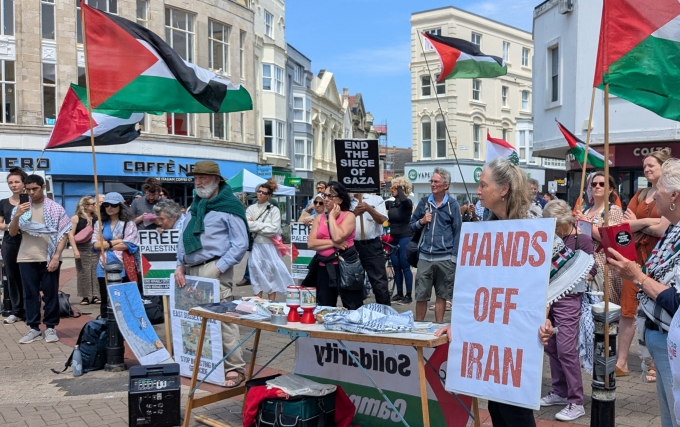
Emergency rally in Hastings town centre, 14 June 2025. Israel had just unleashed attacks across Iran (The 12 Day War.).
And a particular problem within solidarity circles, said Louis, is that discourse is 'often divorced from a broader anti-imperialist analysis, or from the broader regional picture,' and that there remains widespread opposition to armed resistance in Western Asia and Palestine.
'There are legitimate, serious legal concerns about what can and can't be said, and I'm fully sympathetic to that, he said. 'But this problem predates, for example, the wholesale prescription of Hamas in November 2021, so I don't think it can be blamed on that.'
Louis believes the opposition to armed resistance is a reflection of Western exceptionalism, the idea that 'we know better.'
In 2021, Louis observed: 'Large swathes of the Western Left express solidarity with Palestinian cause in a generalized, abstract way, and simultaneously reject the very groups who are currently fighting and dying for it.
'All too often, those who have refused to surrender and steadfastly resisted at great cost are condemned by the people who, in the same breath, declare solidarity with the cause.
'Similarly, it's common for those same people to either ignore or demonize those external forces that materially aid the Palestinian resistance more than any others, most notably Iran.
'If this assistance is acknowledged, which is rare, the Palestinian groups that accept it are typically infantilized as mere dupes or pawns for allowing themselves to extensively be used cynically by the self-serving acts of others, a sentiment that directly contradicts Palestinian leaders own statements about Iran and others.'
Louis argued that this dissonance is reinforced by the current framing of the Palestinian struggle within a 'human rights' discourse when it is in fact an 'anti-colonial struggle for national liberation being waged by an indigenous resistance against an imperialist backed settler colony.'
The overall aim of the struggle is decolonization,' he said.
'The land of Palestine needs to be decolonized, its Zionist colonizers deposed and their racist structures and barriers removed, political and physical. And, of course, all Palestinian refugees given the right of return.'
He added that BDS and nonviolent resistance go hand in hand with this struggle as part of the 'broad spectrum of activities' opposing the Zionist entity.
'It is all important and all legitimate,' he emphasized.
And it is critical for the solidarity movement, he said, how we conceptualize and oppose Zionism and Israel, but also '..how we understand and relate to those movements that fight those two monsters.'
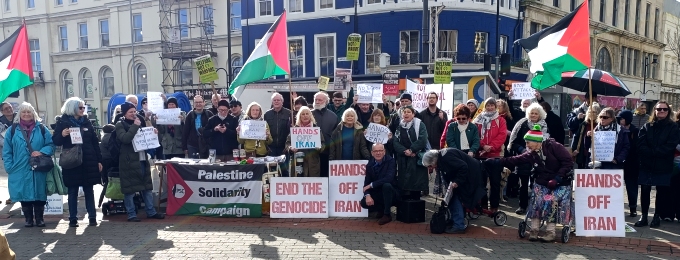
Emergency rally in Hastings town centre called to protest at the US/Israel bombing of Iran. 28 February 2026.
DR HELYEH DOUTAGHI: WESTERN SANCTIONS FORM PART OF A STRATEGY AIMED AT IRANIAN SOVERIGNTY
Dr Helyeh Doutaghi, a scholar in International law, spoke from Tehran, having been fired from her post at Yale University and then deported from the US earlier this year on spurious grounds, as part of what she has called the 'era of Zionist McCarthyism.'
At the meeting she talked about 'imperialist hybrid warfare' on Iran, and specifically sanctions.
'When we talk about Iran it's important to have a critical reading of the material and historical context of sanctions,' she said. These reveal a consistent pattern, she argued, with each phase of sanctions since 1951, coinciding with a 'specific stage of Iranian economic sovereignty, industrial development and technical or military advancement.'
There is a misconception that sanctions on Iran started after the 1979 Iranian Revolution. But that is simply not true.
'Each stage [of sanctions] has been tied to this moment in which a disruption of the flow of value from Iran to the imperial core and reasserting control over the nation's right to self-determination in sovereignty over national resources and indigenous development and a defensive capacity has been targeted.'
She says this becomes visible with a shift in framing the narrative away from the politics of the bodies imposing sanctions and towards 'the material dynamics inside Iran to show how successive sanctions regime have functioned as mechanism to maintain unequal global capitalist development in the context of Iran and West Asia, and how they secure the extraction of wealth and resources to the imperial center and ensure that Iran and Western Asian remain structurally incapable of materially changing Imperial domination.'
Justifications for sanctions have been wrapped in legal and political arguments, resting officially on the three key logics: international security, the fight against terrorism and protection of human rights.
'But in practice, every major wave of sanctions has been triggered by a moment when Iran asserted sovereignty and pursued indigenous industrial or military development,' she said.
'Sanctions have consistently worked to contain and restructure Iran through the dedevelopment, deindustrialization, and disarmament, under the language of security and humanitarian concerns.'
Neither are sanctions isolated tools but work within a '...broader architecture of hybrid imperial warfare, operating in tandem with diplomacy, and direct military aggression designed to reinforce one another.'
Helyeh outlined four major phases in the history of sanctions, all related to an assertion of Iranian sovereignty. The first came after the 'assertion of sovereignty over natural resources' that took place in 1951 when Iran nationalized oil.
This contradicts a common misperception of the sanction regime as being in opposition to the Iranian Revolution, which took place 18 years later.
Nationalizing the oil industry prompted the UK to impose 'comprehensive sanctions' to 'contain the disturbance' that Iran's oil nationalization had caused the global capitalist socioeconomic and political order, said Helyeh. Those sanctions were used to coerce Iran to enter an agreement that would ensure that 'effective control of Iranian oil remained out of Iranian hands.'
The subsequent MI6/CIA-backed coup of Iran's democratically elected leader meant the West successfully 'continued to loot and to steal the nation's oil and the nation's wealth for another three decades.'
The second phase came in 1979 with the revolution, when Iranians decided to assert sovereignty over their political system.
'By reclaiming sovereignty and ending Iran's role as the US regional policeman, as it was said, the Iranian Revolution disturbed the flow of resources to the imperial core, sparking a strategic pivot of US power in the Persian Gulf,' said Helyeh.
Iran conducted a complete oil boycott of Israel immediately after the revolution. This, said Helyeh, representated a 'double loss to imperialism', both in domestic economic policies and also in foreign policy.
'From this point forward, overthrowing the revolution itself as a political project of Iranian sovereignty became the target of sanctions and other hybrid Imperial coercions.'
Iran now represented a real threat to the imperial Zionist project.
'Supporting Palestinian liberation was one of the main pillars of the Islamic Revolution,' she explained. 'And it was not just on the ideological level, but it was very much immediately turned into a very material support of the liberation of Palestinians through creating anti colonial forces and supporting anti colonial forces, both in Palestine, but also helping create anti colonial forces in Lebanon, namely Hezbollah, and also later in Yemen.'
Thus, hostility to the revolution from the US, said Helyeh, was not because it was 'Islamic' in nature, but because of the material impact it had on the imperial project in West Asia.
This view is supported by recently declassified US Government documents showing that regime change was a mission of the United States from 1979.
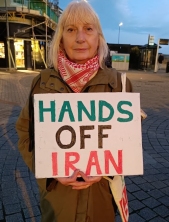
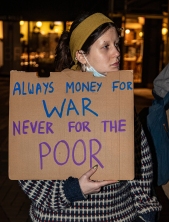
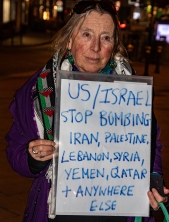
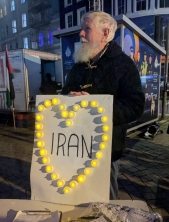
Hands Off Iran protest in Hastings town centre 2 March 2026. 'As Starmer sends British planes to 'defend our allies,' involving us all directly in US and Israel's illegal war, join us again to protest and say no to war on Iran.'
She added that there were different social movements contained within the revolution, including socialists, Islamists, labor movements and feminists, who all played a role. However, immediately after the revolution, all energies were directed to defend the country's sovereignty, under threat from the Western-backed Iraqi invasion of Iran in 1980.
'The project of the revolution remained incomplete because of how much energy was needed to go to protect the borders and the country itself.'
Regime change has been the goal from the start, continuing to this day, as is evidenced by the 12 day war in June when 'United States and the Zionist proxy was hoping to activate regime change operations by relying on conditions that have created through years of sanctions, through their military aggressions.'
From the 1990s onward, the focus of sanctions in their language shifted to Iran's nuclear and military industries.
'This is often narrated as a story of non-proliferation, but what's missing is how deeply it is tied to Iran's pursuit of economic and technological sovereignty,' said Helyeh.
'Iran's nuclear program predates the Islamic Revolution....much of Iran's nuclear program was developed under the Shah with direct Western support.
'The same technology, technologies that were considered modernization in the 70s became after the '79 revolution, a threat to the imperial order.'
Helyeh said that often well-intentioned, well-meaning comrades do great harm when they advance imperialist agendas by 'supporting covert and overt regime change operations of countries that are important to Palestinian struggle.'
She invited the audience to reflect critically on the role of those living in the imperial core.
Those living within Iranian society may have legitimate grievances with the government, she said, 'but without sovereignty, we cannot advance our struggles as Iranian women.'
She emphasized that the struggles of Iranian women and the labor movement have had to become adept at 'protecting their movements from imperialist hijacking.'
'Until and unless we secure our sovereignty from US imperialism in the region, until and unless we have a region free from the Zionist entity and its violence that is inflicting upon us, it's very difficult to advance our rights in Iran, to build societies that we want to live in.
'And I think there's something to be said about the role of our comrades and our friends that are living and paying taxes to the governments that are funding those projects, that are funding the violence that is being inflicted upon us, stealing our struggles from us, because it's way easier for a white American woman, let's say, in Washington, to advance a struggle because there is not a force outside that is stealing their cause from them to inflict regime change in the United States.
'What the imperialist governments are doing makes it that much harder for us than to advance our causes internally.'
When asked by a member of the audience if she thought it likely there would be another war between Israel and Iran, Helyeh replied: 'We are at war. It takes different shapes and forms. But currently, if the Zionist entity and the United States think that they can impose war on Iran, without costs imposed on them, they will not hesitate to attack. And I think that then makes it the question of deterrence for Iran.'
She added that this was 'just a matter of time.'
'The Zionist entity needs war to survive - it feeds off war and destruction and death. So if it can attack Iran without it being destroyed, they will not hesitate for a moment to do so. But I think right now, everyone's regrouping, everyone's reassessing, and the region is in a very dangerous moment, as we have been for the past two years.'
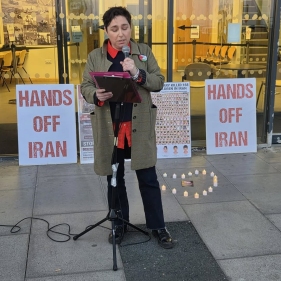
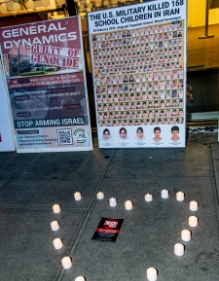
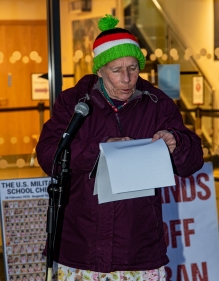
Vigil for the Schoolgirls of Minab. Outside the Council offices, 18 March 2026.
IRFAN CHOWDHURY: ISRAEL IS SET TO UNLEASH 'UNPRECEDENTED LEVELS OF DESTRUCTION AND CALAMITY' ON THE ENTIRE REGION NEXT YEAR
Irfan Chowdhury, a Hastings-based writer and researcher at the University of Brighton, picked up on this 'extraordinarily dangerous' moment in his own talk, one he said was precipitated by the Biden administration's 'unleashing' of Israel in October 2023.
He described the last two years of atrocities on a scale with an 'almost unimaginable level of sadism and barbarism that it's hard to compute.'
And while the Biden administration 'took the brakes off of Israel', the Trump administration continued to build upon that, placing Iran and other countries in the region in a 'deeply dangerous and precarious place.'
Irfan reported that in September this year, Iran offered a diplomatic proposal to the US, France, Germany and the UK related to its nuclear enrichment program. This was to ship all its highly enriched uranium out of the country in return for these countries not reimposing UN sanctions. The US rejected the proposal, saying that it wasn't enough for the highly enriched uranium to be shipped out of the country. And if Iran were to do that, the only thing the US would guarantee is that sanctions wouldn't be reimposed for another few months. After that, they would reimpose sanctions and demand more concessions.
'What this essentially illustrates,' said Irfan. '..is that this issue of nuclear enrichment is essentially a fig leaf. It's being used to simply extract more and more concessions from Iran until Iran basically stops being Iran.'
He added: 'The US is cutting off all diplomatic channels, even while Iran is proposing ideas which are manifestly quite reasonable and are in fact enormous concessions on the Iranian part.'
This has led, said Irfan, to popular support in Iran for a nuclear deterrent, given the aggression from Israel earlier this year, while the Iranian establishment still refuses to pursue a nuclear weapon because, regarding nuclear weapons as unIslamic. There is a sense now, said Irfan, that Iran is 'hunkering down', preparing for the next war, which it sees as inevitable.
They have learnt valuable lessons from earlier this year, he said. One is that when Iran is under existential threat, the country 'comes together in defiance of external aggression'. And another is that its 'ballistic missiles work because they were able to inflict significant destruction on parts of Israel.'
Hence, they are now expanding their missile program.
It is anticipated, said Irfan, that Israel's future bombing of Iran will be 'even more immense and even more unrestrained' than in the previous round, so we're in an extremely dangerous moment and that the coming confrontation will be 'existential' in nature. As an aside, Irfan noted that Britain and America are now themselves in blatant violation of the Nuclear Non Proliferation Treaty.
These countries are meant to be making 'good faith efforts' towards reducing their own nuclear weapons. Instead, Britain is investing money into new research and new technology to upgrade and advance its nuclear weapon stockpile and America is helping Britain to do that.
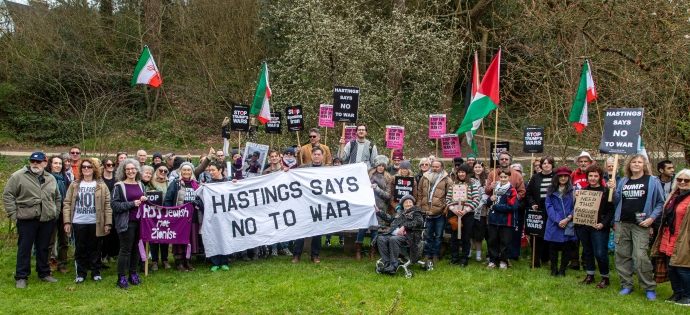
March from Hastings Town Centre to the Peace Garden, Alexandra Park. 29 March 2026. 'End the war against Iran; Stop bombing Lebanon; End Israeli genocide in Gaza.'
Irfan also drew attention to the situation in Southern Lebanon where Israel is still occupying and bombing, violating the terms of the ceasefire they signed last year.
'Israeli soldiers snipe any anyone who tries to return to their homes in the south, preventing reconstruction,' he said.
'It carries out drone strikes against bulldozers that come to clear away the rubble. And a Lebanese newspaper revealed just this week, that in the ongoing talks between Israel and Lebanon, the US and Israel demand is that Israel has to maintain a permanent security strip in southern Lebanon, which means Israel is going to permanently annex part of Southern Lebanon, which is why it's preventing reconstruction of homes.
'Israel's carrying out an ongoing occupation of southern Lebanon. It is occupying five hilltops in the south, and it's gradually expanding those.'
He described Israel's use of drones in southern Lebanon as a 'dystopian nightmare', with the ariel robots now conducting regular stop and search operations, harassing people on foot and in cars.
'Many of these encounters involve civilians and appear intended to intimidate them and remind them that they are constantly being watched,' said Irfan. They enter people's homes, follow them in the streets, representing a menacing and 'pervasive presence'. 'This takes an emotional toll on the local population, which has to do with incessant buzzing and the loss of television signals when a drone is nearby.'
All of this surveillance and harassment, said Irfan, is 'clearly intended to just drive people out of the area.'
'Simultaneously, Israel is expanding its occupation of southern Syria,' he said. 'It kills civilians there. It destroys homes. It burns down olive groves. It's essentially turning southern Syria into the West Bank, and this is all parts of Israel's ongoing realization of its vision of Greater Israel, which includes southern Lebanon and Gaza.
'The genocide in Gaza hasn't stopped, and Israel's goal is still to expel the population there . Israel's attacks in the West Bank are accelerating. Israel is taking more and more land in southern Syria, and Israel also is planning to smash Iran.
'It looks very likely that Israel will relaunch the war in Lebanon in the new year, under the pretext that Hezbollah has not been disarmed, and Israel is planning to launch unprecedented levels of destruction.'
Irfan quoted one analyst of the region who stated it was 'very likely that Israel will commit genocide in Lebanon in the new year.'
'So we're in an extraordinarily dangerous moment,' he concluded. 'At the same time, the forces that oppose Israel in the region are still heavily armed.
'And there's a good case to be made that Israel is miscalculating when it believes that it will simply have an easy victory over these forces in the region, because on the other side of the equation, those forces are rearming, regrouping.
'They're learning the lessons of the past two years, and so the region is at a moment where it looks like an unprecedented level of destruction and calamity is going to befall the entire region, and Israel is likely not going to be exempt from that.'
7 December 2025.
ends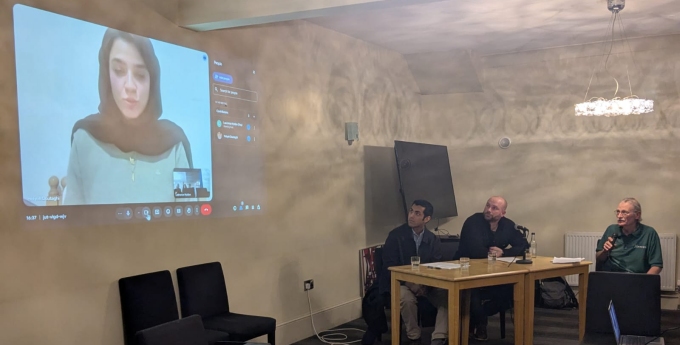
LOUIS ALLDAY: WE CANNOT DIVORCE PALESTINE FROM A BROADER ANTI-IMPERIALIST NARRATIVE
Historian and writer Louis Allday opened the meeting by highlighting the results of a leaked report conducted by Stagwell Global and commissioned by Israel's Ministry of Foreign Affairs this year into attitudes in Europe and the US.
It showed: '....the majority of respondents in all of those countries believe Israel has committed war crimes, and it's killing primarily civilians.'
Further, that the majority in all these countries, except for the US, specifically believe Israel is guilty of genocide and ethnic cleansing.
'So this is clearly very unwelcome and worrying news for the Zionist state and its backers,' said Louis.
'However, results also show, at the same time that a very significant majority of the same publics continue to believe in Israel's right to exist as a state, continue to believe in Israel's right to exist as a Jewish state specifically, and, perhaps most shockingly, a very significant majority would still side with Israel in a conflict between it and both Iran and Hamas.
'In addition, all of these publics would also oppose any future Palestinian state that did not recognize Israel.'
The report recommended that its client's best tactic would be to 'foment fear of "radical Islam and jihadism" to push back against the the plummeting popularity of Israel and Zionism.'
Louis observed that despite the 'horrific' genocide now ongoing for over 700 days, it had not been sufficient for people to break with a number of deeply held beliefs.
'The first being Israel must exist and that a better, non-genocidal, less bad Israel can exist,' he said. 'I would argue that that's an impossibility. Zionism is an inherently genocidal ideology and Israel never has been, is not and can never be anything but what it is. And it's showing us what it is every single day.'
He said people are also struggling to break with a 'strong opposition and negativity towards Iran', readily accepting 'demonizing narratives about it, and other anti-Zionist forces in the region.'
'And so this tells me that a lot of work needs to be done, because while popular outrage is welcome, if it's not grounded in theory and a clear historical understanding of what Israel and Zionism are and who are the forces that actually oppose it and why, then it's going to be potentially shaped in a backtracking fashion, where the outrage and the anger will be funneled back into the belief that those forces that oppose Israel are actually worse than Israel, and Israel is redeemable.'
Louis said we are already seeing attempts to portray the genocide as 'exceptional rather than illustrative', with these attempts to foment fear of jihadism, 'demonizing the very people that have actually suffered for and in many cases, died fighting Israel.'
What is the cause of these deep-seated beliefs?
Louis said that one was the persistence of 'liberal Zionist myths'. Chiefly, that there is a 'redeemable' idea within Zionism, obscuring the fact that it is an 'inherently racist colonial expansionist movement.'
He also pointed out that we do not apply the same level of scrutiny to the media necessary to understand pro-imperialist propaganda.
And a particular problem within solidarity circles, said Louis, is that discourse is 'often divorced from a broader anti-imperialist analysis, or from the broader regional picture,' and that there remains widespread opposition to armed resistance in Western Asia and Palestine.
'There are legitimate, serious legal concerns about what can and can't be said, and I'm fully sympathetic to that, he said. 'But this problem predates, for example, the wholesale prescription of Hamas in November 2021, so I don't think it can be blamed on that.'
Louis believes the opposition to armed resistance is a reflection of Western exceptionalism, the idea that 'we know better.'
In 2021, Louis observed: 'Large swathes of the Western Left express solidarity with Palestinian cause in a generalized, abstract way, and simultaneously reject the very groups who are currently fighting and dying for it.
'All too often, those who have refused to surrender and steadfastly resisted at great cost are condemned by the people who, in the same breath, declare solidarity with the cause.
'Similarly, it's common for those same people to either ignore or demonize those external forces that materially aid the Palestinian resistance more than any others, most notably Iran.
'If this assistance is acknowledged, which is rare, the Palestinian groups that accept it are typically infantilized as mere dupes or pawns for allowing themselves to extensively be used cynically by the self-serving acts of others, a sentiment that directly contradicts Palestinian leaders own statements about Iran and others.'
Louis argued that this dissonance is reinforced by the current framing of the Palestinian struggle within a 'human rights' discourse when it is in fact an 'anti-colonial struggle for national liberation being waged by an indigenous resistance against an imperialist backed settler colony.'
The overall aim of the struggle is decolonization,' he said.
'The land of Palestine needs to be decolonized, its Zionist colonizers deposed and their racist structures and barriers removed, political and physical. And, of course, all Palestinian refugees given the right of return.'
He added that BDS and nonviolent resistance go hand in hand with this struggle as part of the 'broad spectrum of activities' opposing the Zionist entity.
'It is all important and all legitimate,' he emphasized.
And it is critical for the solidarity movement, he said, how we conceptualize and oppose Zionism and Israel, but also '..how we understand and relate to those movements that fight those two monsters.'
Emergency rally in Hastings town centre called to protest at the US/Israel bombing of Iran. 28 February 2026.
DR HELYEH DOUTAGHI: WESTERN SANCTIONS FORM PART OF A STRATEGY AIMED AT IRANIAN SOVERIGNTY
Dr Helyeh Doutaghi, a scholar in International law, spoke from Tehran, having been fired from her post at Yale University and then deported from the US earlier this year on spurious grounds, as part of what she has called the 'era of Zionist McCarthyism.'
At the meeting she talked about 'imperialist hybrid warfare' on Iran, and specifically sanctions.
'When we talk about Iran it's important to have a critical reading of the material and historical context of sanctions,' she said. These reveal a consistent pattern, she argued, with each phase of sanctions since 1951, coinciding with a 'specific stage of Iranian economic sovereignty, industrial development and technical or military advancement.'
There is a misconception that sanctions on Iran started after the 1979 Iranian Revolution. But that is simply not true.
'Each stage [of sanctions] has been tied to this moment in which a disruption of the flow of value from Iran to the imperial core and reasserting control over the nation's right to self-determination in sovereignty over national resources and indigenous development and a defensive capacity has been targeted.'
She says this becomes visible with a shift in framing the narrative away from the politics of the bodies imposing sanctions and towards 'the material dynamics inside Iran to show how successive sanctions regime have functioned as mechanism to maintain unequal global capitalist development in the context of Iran and West Asia, and how they secure the extraction of wealth and resources to the imperial center and ensure that Iran and Western Asian remain structurally incapable of materially changing Imperial domination.'
Justifications for sanctions have been wrapped in legal and political arguments, resting officially on the three key logics: international security, the fight against terrorism and protection of human rights.
'But in practice, every major wave of sanctions has been triggered by a moment when Iran asserted sovereignty and pursued indigenous industrial or military development,' she said.
'Sanctions have consistently worked to contain and restructure Iran through the dedevelopment, deindustrialization, and disarmament, under the language of security and humanitarian concerns.'
Neither are sanctions isolated tools but work within a '...broader architecture of hybrid imperial warfare, operating in tandem with diplomacy, and direct military aggression designed to reinforce one another.'
Helyeh outlined four major phases in the history of sanctions, all related to an assertion of Iranian sovereignty. The first came after the 'assertion of sovereignty over natural resources' that took place in 1951 when Iran nationalized oil.
This contradicts a common misperception of the sanction regime as being in opposition to the Iranian Revolution, which took place 18 years later.
Nationalizing the oil industry prompted the UK to impose 'comprehensive sanctions' to 'contain the disturbance' that Iran's oil nationalization had caused the global capitalist socioeconomic and political order, said Helyeh. Those sanctions were used to coerce Iran to enter an agreement that would ensure that 'effective control of Iranian oil remained out of Iranian hands.'
The subsequent MI6/CIA-backed coup of Iran's democratically elected leader meant the West successfully 'continued to loot and to steal the nation's oil and the nation's wealth for another three decades.'
The second phase came in 1979 with the revolution, when Iranians decided to assert sovereignty over their political system.
'By reclaiming sovereignty and ending Iran's role as the US regional policeman, as it was said, the Iranian Revolution disturbed the flow of resources to the imperial core, sparking a strategic pivot of US power in the Persian Gulf,' said Helyeh.
Iran conducted a complete oil boycott of Israel immediately after the revolution. This, said Helyeh, representated a 'double loss to imperialism', both in domestic economic policies and also in foreign policy.
'From this point forward, overthrowing the revolution itself as a political project of Iranian sovereignty became the target of sanctions and other hybrid Imperial coercions.'
Iran now represented a real threat to the imperial Zionist project.
'Supporting Palestinian liberation was one of the main pillars of the Islamic Revolution,' she explained. 'And it was not just on the ideological level, but it was very much immediately turned into a very material support of the liberation of Palestinians through creating anti colonial forces and supporting anti colonial forces, both in Palestine, but also helping create anti colonial forces in Lebanon, namely Hezbollah, and also later in Yemen.'
Thus, hostility to the revolution from the US, said Helyeh, was not because it was 'Islamic' in nature, but because of the material impact it had on the imperial project in West Asia.
This view is supported by recently declassified US Government documents showing that regime change was a mission of the United States from 1979.
She added that there were different social movements contained within the revolution, including socialists, Islamists, labor movements and feminists, who all played a role. However, immediately after the revolution, all energies were directed to defend the country's sovereignty, under threat from the Western-backed Iraqi invasion of Iran in 1980.
'The project of the revolution remained incomplete because of how much energy was needed to go to protect the borders and the country itself.'
Regime change has been the goal from the start, continuing to this day, as is evidenced by the 12 day war in June when 'United States and the Zionist proxy was hoping to activate regime change operations by relying on conditions that have created through years of sanctions, through their military aggressions.'
From the 1990s onward, the focus of sanctions in their language shifted to Iran's nuclear and military industries.
'This is often narrated as a story of non-proliferation, but what's missing is how deeply it is tied to Iran's pursuit of economic and technological sovereignty,' said Helyeh.
'Iran's nuclear program predates the Islamic Revolution....much of Iran's nuclear program was developed under the Shah with direct Western support.
'The same technology, technologies that were considered modernization in the 70s became after the '79 revolution, a threat to the imperial order.'
Helyeh said that often well-intentioned, well-meaning comrades do great harm when they advance imperialist agendas by 'supporting covert and overt regime change operations of countries that are important to Palestinian struggle.'
She invited the audience to reflect critically on the role of those living in the imperial core.
Those living within Iranian society may have legitimate grievances with the government, she said, 'but without sovereignty, we cannot advance our struggles as Iranian women.'
She emphasized that the struggles of Iranian women and the labor movement have had to become adept at 'protecting their movements from imperialist hijacking.'
'Until and unless we secure our sovereignty from US imperialism in the region, until and unless we have a region free from the Zionist entity and its violence that is inflicting upon us, it's very difficult to advance our rights in Iran, to build societies that we want to live in.
'And I think there's something to be said about the role of our comrades and our friends that are living and paying taxes to the governments that are funding those projects, that are funding the violence that is being inflicted upon us, stealing our struggles from us, because it's way easier for a white American woman, let's say, in Washington, to advance a struggle because there is not a force outside that is stealing their cause from them to inflict regime change in the United States.
'What the imperialist governments are doing makes it that much harder for us than to advance our causes internally.'
When asked by a member of the audience if she thought it likely there would be another war between Israel and Iran, Helyeh replied: 'We are at war. It takes different shapes and forms. But currently, if the Zionist entity and the United States think that they can impose war on Iran, without costs imposed on them, they will not hesitate to attack. And I think that then makes it the question of deterrence for Iran.'
She added that this was 'just a matter of time.'
'The Zionist entity needs war to survive - it feeds off war and destruction and death. So if it can attack Iran without it being destroyed, they will not hesitate for a moment to do so. But I think right now, everyone's regrouping, everyone's reassessing, and the region is in a very dangerous moment, as we have been for the past two years.'
IRFAN CHOWDHURY: ISRAEL IS SET TO UNLEASH 'UNPRECEDENTED LEVELS OF DESTRUCTION AND CALAMITY' ON THE ENTIRE REGION NEXT YEAR
Irfan Chowdhury, a Hastings-based writer and researcher at the University of Brighton, picked up on this 'extraordinarily dangerous' moment in his own talk, one he said was precipitated by the Biden administration's 'unleashing' of Israel in October 2023.
He described the last two years of atrocities on a scale with an 'almost unimaginable level of sadism and barbarism that it's hard to compute.'
And while the Biden administration 'took the brakes off of Israel', the Trump administration continued to build upon that, placing Iran and other countries in the region in a 'deeply dangerous and precarious place.'
Irfan reported that in September this year, Iran offered a diplomatic proposal to the US, France, Germany and the UK related to its nuclear enrichment program. This was to ship all its highly enriched uranium out of the country in return for these countries not reimposing UN sanctions. The US rejected the proposal, saying that it wasn't enough for the highly enriched uranium to be shipped out of the country. And if Iran were to do that, the only thing the US would guarantee is that sanctions wouldn't be reimposed for another few months. After that, they would reimpose sanctions and demand more concessions.
'What this essentially illustrates,' said Irfan. '..is that this issue of nuclear enrichment is essentially a fig leaf. It's being used to simply extract more and more concessions from Iran until Iran basically stops being Iran.'
He added: 'The US is cutting off all diplomatic channels, even while Iran is proposing ideas which are manifestly quite reasonable and are in fact enormous concessions on the Iranian part.'
This has led, said Irfan, to popular support in Iran for a nuclear deterrent, given the aggression from Israel earlier this year, while the Iranian establishment still refuses to pursue a nuclear weapon because, regarding nuclear weapons as unIslamic. There is a sense now, said Irfan, that Iran is 'hunkering down', preparing for the next war, which it sees as inevitable.
They have learnt valuable lessons from earlier this year, he said. One is that when Iran is under existential threat, the country 'comes together in defiance of external aggression'. And another is that its 'ballistic missiles work because they were able to inflict significant destruction on parts of Israel.'
Hence, they are now expanding their missile program.
It is anticipated, said Irfan, that Israel's future bombing of Iran will be 'even more immense and even more unrestrained' than in the previous round, so we're in an extremely dangerous moment and that the coming confrontation will be 'existential' in nature. As an aside, Irfan noted that Britain and America are now themselves in blatant violation of the Nuclear Non Proliferation Treaty.
These countries are meant to be making 'good faith efforts' towards reducing their own nuclear weapons. Instead, Britain is investing money into new research and new technology to upgrade and advance its nuclear weapon stockpile and America is helping Britain to do that.
Irfan also drew attention to the situation in Southern Lebanon where Israel is still occupying and bombing, violating the terms of the ceasefire they signed last year.
'Israeli soldiers snipe any anyone who tries to return to their homes in the south, preventing reconstruction,' he said.
'It carries out drone strikes against bulldozers that come to clear away the rubble. And a Lebanese newspaper revealed just this week, that in the ongoing talks between Israel and Lebanon, the US and Israel demand is that Israel has to maintain a permanent security strip in southern Lebanon, which means Israel is going to permanently annex part of Southern Lebanon, which is why it's preventing reconstruction of homes.
'Israel's carrying out an ongoing occupation of southern Lebanon. It is occupying five hilltops in the south, and it's gradually expanding those.'
He described Israel's use of drones in southern Lebanon as a 'dystopian nightmare', with the ariel robots now conducting regular stop and search operations, harassing people on foot and in cars.
'Many of these encounters involve civilians and appear intended to intimidate them and remind them that they are constantly being watched,' said Irfan. They enter people's homes, follow them in the streets, representing a menacing and 'pervasive presence'. 'This takes an emotional toll on the local population, which has to do with incessant buzzing and the loss of television signals when a drone is nearby.'
All of this surveillance and harassment, said Irfan, is 'clearly intended to just drive people out of the area.'
'Simultaneously, Israel is expanding its occupation of southern Syria,' he said. 'It kills civilians there. It destroys homes. It burns down olive groves. It's essentially turning southern Syria into the West Bank, and this is all parts of Israel's ongoing realization of its vision of Greater Israel, which includes southern Lebanon and Gaza.
'The genocide in Gaza hasn't stopped, and Israel's goal is still to expel the population there . Israel's attacks in the West Bank are accelerating. Israel is taking more and more land in southern Syria, and Israel also is planning to smash Iran.
'It looks very likely that Israel will relaunch the war in Lebanon in the new year, under the pretext that Hezbollah has not been disarmed, and Israel is planning to launch unprecedented levels of destruction.'
Irfan quoted one analyst of the region who stated it was 'very likely that Israel will commit genocide in Lebanon in the new year.'
'So we're in an extraordinarily dangerous moment,' he concluded. 'At the same time, the forces that oppose Israel in the region are still heavily armed.
'And there's a good case to be made that Israel is miscalculating when it believes that it will simply have an easy victory over these forces in the region, because on the other side of the equation, those forces are rearming, regrouping.
'They're learning the lessons of the past two years, and so the region is at a moment where it looks like an unprecedented level of destruction and calamity is going to befall the entire region, and Israel is likely not going to be exempt from that.'
7 December 2025.
ends
